
 EN
Technical Foundation and Fiber Dynamics in Bamboo Cotton Weaving
Managing structural dimensional stability during textile manufacturing requires a thorough understanding of fiber hygroscopicity, yarn tension, and warp-weft crimp geometry. Natural bamboo rayon fibers exhibit substantial moisture absorption capacity and directional swelling when exposed to aqueous environments, making raw yarns prone to structural contraction during wet finishing. To manage these natural tendencies, modern textile engineers blend soft bamboo cellulose with stable cotton staples to create premium bamboo cotton fabric that delivers exceptional breathability, liquid transport, and skin-friendly softness. Working closely with specialized spinning facilities, technicians focus on controlling the twist multiplier and maintaining uniform moisture regain before warping begins. When crafting luxurious textiles for western niche loungewear brands and eco-friendly home apparel collections, precise yarn conditioning relaxes latent internal stresses caused by high-speed spinning. Establishing stable fiber alignment at this foundational phase reduces post-wash length variation and helps prevent excessive fabric distortion in consumer products.
Precision Tension Management Across Warping and Sizing Operations
The warping and sizing stages play a critical role in preventing excessive lengthwise fabric shrinkage during subsequent weaving operations. Over-stretching yarns during sizing permanently elongates cellulosic fibers, which naturally rebound and contract once the finished garment encounters moisture. Experienced weaving mill managers maintain strict oversight on warp sheet tension, ensuring sizing stretch ratios remain carefully controlled rather than stretched under excessive mechanical strain. Applying a uniform, protective size formula consisting of modified starches and gentle binder agents protects the delicate bamboo cotton fabric fibers against high-frequency loom friction while preserving natural yarn elasticity. In our state-of-the-art weaving facility, real-time electronic tension sensors monitor individual warp threads to eliminate uneven stretch across the beam width. Adhering to strict international textile safety guidelines such as OEKO-TEX Standard 100, Global Organic Textile Standard, and Global Recycled Standard, our precise sizing protocols guarantee clean yarn strength, minimal structural distortion, and exceptional environmental safety.
Loom Parameter Calibration and Real-Time Weaving Control
Optimizing loom parameters is essential for achieving precise pick density and balanced tension geometry during active cloth formation. Running high-speed air-jet or rapier looms with excessive off-loom warp tension forces warp ends into unnatural elongation, increasing ultimate fabric contraction upon relaxation. Mill technicians carefully tune shed opening timing and lower overall warp tension to the minimum threshold necessary for clean shed clearance, reducing mechanical strain on the bamboo cotton fabric. Furthermore, selecting appropriate rubberized ring temples helps maintain consistent fabric width at the fell of the cloth, preventing edge contraction and regulating weft-way crimp angles. During a recent production run for an international luxury sleepwear brand, our engineering team adjusted the loom beat-up profile and pick insertion timing, effectively stabilizing the mechanical crimp balance. This real-time calibration minimized residual relaxation shrinkage across large batch production rolls without compromising fabric density or hand feel.
Real-World Applications and Lifestyle Comfort Integration
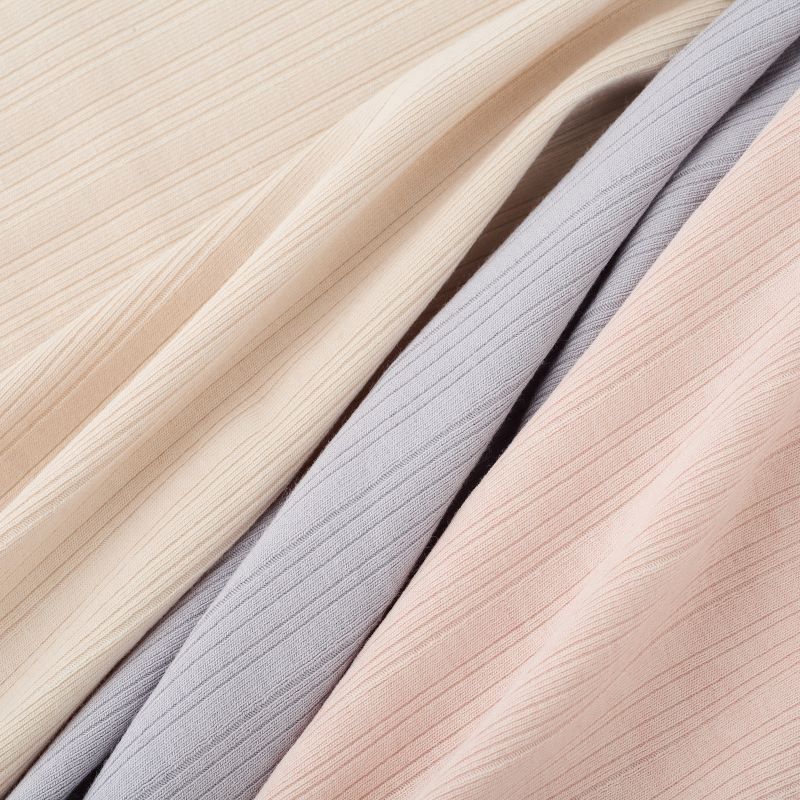
The refined texture, silky drape, and natural thermal regulation of bamboo cotton fabric make it an ideal choice for high-end fashion and lifestyle apparel applications. This versatile textile performs exceptionally well in boutique lounge sets, delicate nightwear, light summer tops, and premium home apparel crafted for discerning global consumers. Beyond residential loungewear, its natural moisture management and gentle touch make it equally suitable for sensitive infant clothing, lightweight travel garments, and eco-friendly casual lines. European and American apparel designers value this balanced material because it combines the natural cooling effect of bamboo with the durable structure of premium cotton. By carefully controlling yarn geometry during weaving, the finished cloth retains its smooth surface, elegant drape, and reliable sizing through repeated domestic laundry cycles. This reliable dimensional stability enhances product longevity, reduces customer returns, and strengthens brand loyalty in competitive apparel markets.
Quality Assurance Standards and Global Custom Supply Capabilities
Delivering consistent, high-specification textiles requires rigorous quality auditing at every stage of manufacture, from raw material procurement to final packing. Every batch of bamboo cotton fabric undergoes comprehensive lab testing, including burst strength evaluation, colorfastness checks, and multi-cycle dimensional stability testing in accordance with international ISO standards. Our integrated manufacturing system offers flexible minimum order quantities starting at reasonable production limits, allowing both growing independent fashion labels and established global brands to customize dye colors, weave patterns, and finishing treatments with ease. Certified under OEKO-TEX, GOTS, and GRS frameworks, our production facilities provide fully traceable, eco-conscious textile solutions that meet strict environmental and human-ecological requirements. If you are developing an upcoming apparel line or seeking custom-woven fabrics with superior dimensional performance, contact our technical sales team today to request sample swatches and discover how our specialized manufacturing expertise can support your brand goals.
Table of Contents
- Technical Foundation and Fiber Dynamics in Bamboo Cotton Weaving
- Precision Tension Management Across Warping and Sizing Operations
- Loom Parameter Calibration and Real-Time Weaving Control
- Real-World Applications and Lifestyle Comfort Integration
- Quality Assurance Standards and Global Custom Supply Capabilities